May 14th, 2008
EDIT: The texture monitor is now obsolete. As of 6.4, AC3D now includes its own, much better texture monitor.
A new version of the AC3D texture monitor plugin is available! This version adds a “smart update” feature that prevents the same texture from being reloaded multiple times, even if you use the texture multiple times in your scene. The texture monitor now also ignores files who’s “last modified” time stamp has not changed on disk within the last 10 minutes, so textures you haven’t changed don’t get reloaded. This should make load times much faster, especially in large, heavily-textured scenes.
Enjoy!
Read about the texture monitor or download the file here.
Tags: ac3d, cg, cgi, disk monitor, images, paint, plugins, reload, tcp/ip, texture map, texture monitor
Posted in General, Tools and Plugins | Comments Off on Texture Monitor Updated
May 13th, 2008
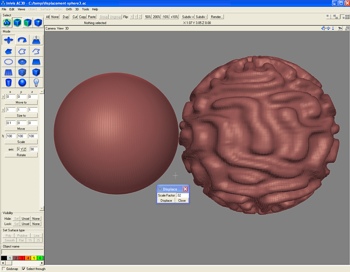
This plugin adds displacement map support to AC3D. Displacement mapping is a technique that deforms the current geometry, displacing the vertices in accordance with elevation values stored in a texture map. This technique is useful for “painting on” details onto a very high resolution mesh.
Displacement maps can be painted with 2D art tools such as Corel, Photoshop or Gimp; or, they can be exported from 3D sculpting programs such as ZBrush or Mudbox. The AC3D displacement map plugin supports 8-bit grayscale and 16-bit red-green (POV-Ray format) displacement maps.
If you are new to displacement mapping, this tutorial explains the process in more detail.
Download the plugin. (Requires Windows XP, AC3D 6.2 or above.)
Tags: ac3d, bump map, cg, cgi, computer graphics, displacement map, height field, heightfield, Mudbox, normal map, POV-Ray, ZBrush
Posted in General, Tools and Plugins | 3 Comments »
May 9th, 2008
If this isn’t the coolest new geek-toy, I don’t know what is! Fold.it is a new game by Rosetta@home where players fold proteins for high scores. Shockingly, it’s actually a lot of fun–you can think of it sort of like a super-advanced version of Tetris. A training mode walks players through the basics, and a challenge mode allows players to compete worldwide to see who has the most l33t folding skillz.

Fold.It – Who says serious games can’t be fun, too?
The goals of the research project are to learn what strategies human players use to solve the very complex problem of protein folding so the same techniques can be taught to computers. In addition, players will soon be able to solve protein folding “puzzles” that computers haven’t yet solved. While the puzzles currently available are all proteins where the real-life structure is known, plans are to release proteins where the structure is unknown in the very near future–allowing players to participate in real-world research and help save lives. If any break-throughs do occur, researchers have promised to share credit with the player who solved it. How cool is that?
Eventually, players may even be able to design their own proteins!
Download it now: Fold-It
Tags: computer games, protein folding, puzzles, rosetta, science, serious games, video games
Posted in General, Totally Off-Topic | Comments Off on Solve Puzzles for Science
May 7th, 2008
Here’s a fun one! Ever wanted to re-create the look of heavy “toon” outlines, but didn’t have a shader for it? Believe it or not, there’s an easy way to fake it using fixed-function only.
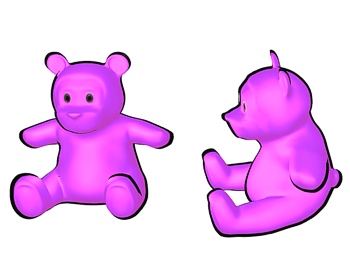
Here’s how to do it:
- Make sure all your surface normals are unified (facing outwards) and your polygons are set to 1-sided
- Make a copy of your object and resize it so it is ever-so-slightly larger than the original
- On the copy, set the surface material to black
- Invert the surface normals
That’s it! Nifty, eh? The method’s not perfect–for best results, stick to convex objects–but it’s great for quick renders and on limited hardware platforms where shaders aren’t an option.
Tags: ac3d, cg, cgi, computer graphics, hacks, non-photorealistic rendering, raytracing, rendering, toon shading, tricks
Posted in 3D Tutorials, General | Comments Off on Fake Toon Outlines
April 24th, 2008
“I have always wished for my computer to be as easy to use as my telephone; my wish has come true because I can no longer figure out how to use my telephone.”
– Bjarne Stroustrup
Tags: Bjarne Stroustrup, c++, complexity, computers
Posted in General | Comments Off on Quote of the Day


